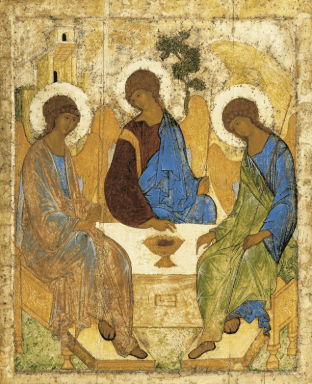
God is love, (1 Jn. 4:8) therefore, God must be a Trinity. God is one shared essence (Deut. 6:4, 2 Pet. 1:4) existing eternally in three divine and distinct persons: Father, Son, and Holy Spirit (Mt. 28:19). There is no god before or after the one God of the Bible (Isa. 40:25; 43:10). It is out of the overflow of this eternal love that He freely creates.
In sovereign power God created intentionally (Isa. 43:7), with order (Eccl. 1:4-7) and purpose (Jn. 17:20-26). God created over six days and rested on the seventh day. Yet, Peter says, “…with the Lord one day is as a thousand years, and a thousand years as one day.” (2 Pet. 3:8). God could have created over a literal seven days. Alternatively, God could have taken an extended period of time like thousands, millions, or billions of years. It is not beyond God to speak things like light into existence immediately (Gen. 1:3) or to control creation like Jesus calming a storm (Mk. 4:39). We also know that God is patient (Rom. 2:4, 1 Cor. 13:4, 2 Pet. 3:9). But the purpose for Genesis 1 is not explanatory in nature but to remind us that God is the creator and sustainer of all.
He has eternally existed as the uncreated Creator (Jn. 17:5) outside of space (Gen. 1:2), time (Gen. 1:3-5; 14-19), and matter (Gen. 1:6-13; 20-31) creating all (Heb. 3:4) and sustaining all things (Heb. 1:3). This means nothing in creation occurs outside of His limitless knowledge, will, or awareness (Ps. 139:1-16). This provides assurance that redemption is not uncertain or reactive but firmly grounded in His eternal purpose (Gen. 3:14).
The God of all things creates out of love. He redeems out of love. We want to spend eternity with Him because He is love. Redemption is possible because God’s holiness, justice, and mercy are inseparable from His love. This makes His plan of redemption possible only through the Son, Jesus Christ. Christ takes on an eternal punishment (Mt. 25:46a) as a perfect, willing, and eternal sacrifice. Christ does this for shared glory with the Father and Spirit that we might inherit their eternal righteousness (1 Cor. 2:7, Mt. 25:46b). Only this God would be willing to lay down His life to redeem His creation. Anything less than the doctrine of the Trinity leads to idol worship. Such a God is not worth turning to, living for, or spending eternity with. The Trinity grounds creation, redemption, and the completion of Christ’s glorious return at the end of time.
God is one day returning on the clouds to judge (Mt. 24:30), to bring justice upon all who do not believe in His name and to deliver the oppressed. (Mt. 13:40-42). Yet for those who have received the Holy Spirit through grace and faith in Jesus Christ, redemption results in new life (2 Cor. 5:17). Not because of anything done by human effort or the will of man, but by the will of God alone (Jn. 1:12–13). Those who receive Christ are not only forgiven but are made children of God and eternal coheirs with Christ (Rom. 8:17).
In the last days, a new heaven and new earth will meet (Rev. 21:1). This does not mean God’s current creation is not good. Rather, it has been marred by the stain of sin. Like the cleansing of the flood, a final cleansing (Gen. 6:7; 6:13; 7:4) will occur at the second coming of Christ. Those found in Christ will be raised physically from the dead – given new, glorified bodies to enjoy the return of Eden for eternity.
Redemption reveals the glory of God while graciously restoring His people to their intended purpose (Isa. 43:7). Humanity was created by God and saved by God, for God to display His glory and love. Redemption reveals God’s mercy toward sinners – showing His faithfulness to His eternal purpose – bringing creation to its intended fulfillment in Him.
All of this good news is because of the doctrine of the Trinity. It is the foundation of the Christian faith. Without the Trinity, love is no longer eternal, creation becomes an act of necessity, and redemption loses coherence. It is only within the triune life of God that love, holiness, and salvation hold together. To lose the Trinity is to lose the God of the Gospel (Gal. 1:6-9).
 Lit Lamp For The Soul