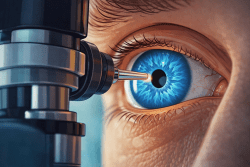
Part of my high school graduation plan involved shadowing a career for a day. My choice was the local eye doctor. The eye doctor I chose was a nearby childhood friend of my dad. I remember that day vividly. There was so much technology, science, and interesting tools for seeing the intricacies of the human eye. I literally saw the eye doctor pull a microscopic piece of metal from a patient’s eye with tweezers! The thought came into my mind, one day I could be called:
Dr. O’Donnell, Optometry PhD.
However, the thought quickly dissipated after learning the amount of education that would be required.
First, I would need a bachelor’s degree in a related field like biology. Science was my worst subject. Then, if I wanted to become an optometrist, I would need four additional years. This would mean four additional years of optometry school to be called Dr. O’Donnell. I was barely getting by in high school. No way was eight years of post-secondary education in my future.
But please don’t ever tell me that God doesn’t have a sense of humor. My academic performance or lack thereof in high school carried over into college.
My journey to a bachelor’s degree in special education spanned eight years. It included:
- Three schools
- One drop out
- Multiple classes dropped
- Multiple classes failed
- Academic probation
To make matters worse, my degree didn’t even come with a teaching certificate. This forced me to attend four more years at another college to obtain a level one teaching license, which once earned is only good for six years. Level one teachers are then required by the state to complete four more years of school to earn a level two teaching license, which gives me a master’s degree and is good for ninety-nine years. That’s sixteen years of education in total. Maybe I should have sucked it up.
In hindsight, eight years to become an eye doctor doesn’t sound so bad.
Through all that rambling, I hope you heard my master’s in education is complete. It seemed my never-ending educational marathon was coming to an end. I thought crossing the academic finish line meant a season of rest was coming. Yet again, God had different plans.
His plans didn’t make sense to me. I discovered a theological course offered by the Evangelical Free Church of America (EFCA). That’s the next logical step, right? Enrolling in the class that is meant to cause extreme mental fatigue from reading theologically heavy books and writing a two-to-three-page reflection paper for each of the ten articles of the EFCA’s Statement of Faith (SOF). Then, I meet with my class, once a month to discuss and defend the positions in my paper. Maybe it is logical, but it didn’t feel logical to me.
Yet, it didn’t surprise me that God made me zig when I wanted to zag. Rather than sitting on my phone scrolling mindlessly, which I admittedly still do, God opened a door for me to go through.
God: “Matthew, look, don’t you see?”
Me: “Yes, Lord, but I just want to rest.”
God: “No! Get up and go.”
“…let us run with endurance the race that is set before us, looking to Jesus…”
— Hebrews 12:1b–2a
When I think about rest, God tells me to run. I’m not told to walk or jog, but to run with endurance because of the hope I have in Jesus. This doesn’t mean there isn’t a season for rest. Rest, when done properly with God, is biblical. But while I wanted to sit on my comfortable couch, Jesus said,
“You shall love the Lord your God with all your heart and with all your soul and with all your mind and with all your strength.”
— Mark 12:30
A theological course forces you to exercise the mind. Your mind will be wrestling with difficult questions that haven’t be answered for over 2,000 years. For instance, the first subject covered in my theological class was EFCA’s first article, the doctrine of God. I got to watch a video, read five chapters in Wayne Grudem’s Systematic Theology and one chapter in Evangelical Convictions. All this was to prepare me to discuss and defend my positions.
There are two typically topics up for debate when discussing the Doctrine of God. First is the New Earth versus Old Earth creation story. Did God create in a literal twenty-four-hour seven-day period? Or did creation take thousands, millions, billions, or even trillions of years?
Then the topic shifts to something deeper.
God’s sovereignty over creation and how that coexists with human free will. The two sides of the topic are most closely linked to Calvinism and Arminianism.
Calvinists believe God preordained everything, including those He elected or predestined for salvation. Acceptance of salvation is brought about by God alone.
Arminians believe in humanity’s freedom to choose. Each person decides whether or not to accept the free gift of grace offered by Jesus.
Before stepping into a theological course, my brain had already been frightened by these doctrinal debates. I’ve stayed up late into the night questioning what is right versus what is wrong—so much so that when people say Calvin, Arminian, elect, or free will—I tend to duck my head inside my shirt like a turtle because I either don’t know the answer or don’t want to debate.
Toward the end of our class discussion, which was very cordial by the way, one participant spoke up. He hadn’t said much during class, if anything at all. This made his statement all the more profound. He said:
“When we are talking about an infinite God, we finite beings, are looking through a keyhole into the eternity. While these topics are fun, too often I’ve seen them divide and that needs to stop. I’m thankful that my salvation isn’t dependent on Calvinism or Arminianism—New Earth or Old Earth. Its only dependence is in Christ.”
His words took me back to the day I shadowed that eye doctor. I recently had my annual eye exam, which included dilation of my pupils. Because of that shadowing experience, I knew my doctor didn’t have a full picture of the inner workings of my eye. All that steady work—all that discomfort for the patient—just to see a small portion of the inner eye. How can a doctor determine whether my eye is healthy at all? Yet, through different tests, including dilation, my doctor can still be relatively certain about the health of my eye. He doesn’t need the entire picture.
In the same way, we look through a microscope to better know God. Our microscope is Scripture. While we only see a partial picture of who God is, we know enough to live. As Paul writes:
“All Scripture is breathed out by God and profitable for teaching, for reproof, for correction, and for training in righteousness…”
— 2 Timothy 3:16
We know only what God thinks we need to know. Yes, we have questions, but answers will not come until eternity. Even then, I don’t think we will be asking many questions, if any at all. I once told an older gentleman in my church how that when I get to heaven, I’ll have so many questions for God. He smiled and said, “That may be true, but I doubt you’ll ask any of them, because you’ll be too awestruck by His glory and too busy worshiping to ask.”
I think he’s right. All my questions will fade into the glory of God. We will be like the seraphim in Isaiah, constantly enamored with His glory, singing:
“Holy, holy, holy is the Lord Almighty.”
— Isaiah 6:3
I want to know more. I really do.
But like an eye doctor, I can still diagnose what is true with a partial view, knowing that one day, my eternal life will finally be filled with His glory.
 Lit Lamp For The Soul
Leave a comment